
28 Oct 2026
THE BUYER'S GUIDE / SELECTION
Selecting the right welded steel grating means matching material grade, load rating, surface treatment, and dimensional configuration to the conditions of your specific application. This guide walks procurement teams and project engineers through the key criteria — from carbon steel versus stainless steel choices to slip-resistance requirements and coating durability — so that every specification decision is grounded in verified product data rather than assumptions.
Material grade and corrosion resistance: Carbon Steel Q235/A36 (yield ≥ 250 MPa) for heavy industrial/indoor use; hot-dip galvanized steel (ASTM A123, 85–100 µm zinc, 1,500+ hours salt-spray resistance) for outdoor and coastal environments; stainless steel 304/316L (ASTM A480, PREN 18–25, Ra ≤ 1.6 µm) for chemical, food-grade, or acidic service conditions.
Load capacity and structural rating: Static load up to 10 kN/m² in standard form; heavy-duty configurations rated 10–40 kN/m² (EN 1991-1-1); dynamic impact resistance per ASTM E23 Charpy ≥ 27 J at −20 °C; deflection verified at ≤ L/200 under 1.5× design load (EN 1990). Panel thickness range 3–10 mm and bar spacing 30/40/50 mm must match span and live load conditions confirmed by a structural engineer.
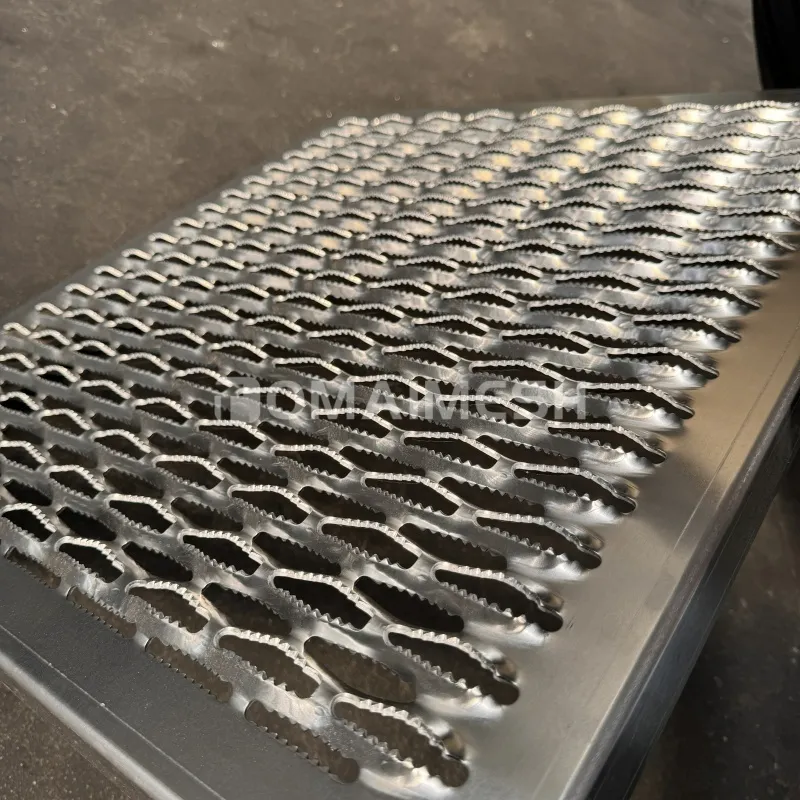
Surface treatment and slip resistance: Hot-dip galvanizing (80–120 µm) for corrosion protection; serrated/grit-coated surfaces rated DIN 51130 R10–R13 for OSHA 1910.23 anti-slip compliance; epoxy/polyurethane coatings (ISO 12944 C4/C5) for chemically aggressive environments; electropolished stainless finish (Ra ≤ 1.6 µm) for hygienic food-processing applications.
Construction method: Electric resistance welding (AWS D1.1, ±1.5 mm crossbar tolerance) for high-traffic platforms requiring uniform load distribution; press-locked interlocked bearing bars for zero-slip junction performance in refinery treads and parking garages.
Welded steel grating is a load-bearing grid panel manufactured by resistance-welding or press-locking bearing bars and cross bars into a rectangular matrix. The result is a rigid, open-surface structure used wherever personnel access, drainage, ventilation, and structural support must coexist — from industrial mezzanines to offshore platform flooring.
TOMAIMESH® RELIABLE & PRECISE. supplies welded steel grating panels in a range of materials, dimensions, and surface treatments designed to match demanding industrial, infrastructure, and commercial environments.
The operating environment is the first filter for any welded steel grating purchase.
| Material | Typical Yield Strength | Best-Fit Environments |
|---|---|---|
| Carbon Steel Q235 / ASTM A36 | ≥ 250 MPa | Heavy industrial platforms, truck docks, warehouse mezzanines |
| Hot-Dip Galvanized Steel (ASTM A123) | ≥ 250 MPa base | Water treatment plants, coastal walkways (salt-spray resistance: 1,500+ hours) |
| Stainless Steel 304 / 316L (ASTM A480) | Higher corrosion resistance | Chemical processing, food-grade facilities, refinery walkways |
Carbon steel (Q235 / A36) is the most economical choice for dry, sheltered, or heavily trafficked indoor installations. Hot-rolled or cold-rolled options support yield strength ≥ 250 MPa, meeting the baseline for heavy industrial platforms.
Hot-dip galvanized steel provides an 85–100 µm zinc coating and is rated at 1,500+ hours of salt-spray resistance, making it appropriate for outdoor infrastructure, water treatment facilities, and coastal installations where long-term corrosion protection matters. Expected service life in humidity-rich environments exceeds 25 years under normal maintenance conditions.
Stainless steel 304 / 316L delivers a PREN of 18–25 and a surface finish of Ra ≤ 1.6 µm — the grade of choice wherever chemical fumes, acid exposure, or hygienic standards (such as FDA food-processing requirements) apply. Grade 316L is specifically suited to acidic environments because of its molybdenum content.
Load requirements vary significantly by application. Specifying under-rated grating risks structural failure; over-specifying drives unnecessary cost.
Verify the actual installed span and live load with your structural engineer before finalizing panel thickness (available range: 3 mm–10 mm) and bar spacing (30 mm / 40 mm / 50 mm).
Slip resistance is a safety-critical criterion for any access surface. The available surface treatment options address both corrosion protection and traction:
OSHA 1910.23 compliance (open riser stairs and catwalks) depends on selecting a surface treatment that meets the required slip-resistance class for the intended traffic type and environmental condition.
Standard panels are produced at 1 m × 6 m. Custom-cut sizes are available to suit tight industrial spaces or retrofit projects.
For press-locked construction, interlocked bearing bars eliminate weld points at junctions while providing zero-slip performance — a specification often preferred in refinery stair treads and parking garages.
| Construction | Key Characteristic | Typical Use |
|---|---|---|
| Electric Resistance Welding | Uniform crossbars ±1.5 mm tolerance; full penetration joints (AWS D1.1 / robotic welding) | High-traffic pedestrian bridges, factory floors, OSHA-compliant load distribution |
| Press-Locked | Interlocked bearing bars; no weld at crossbar junction | Refinery stair treads, parking garages, applications requiring zero-slip at junctions |
Robotic welding (AWS D1.1) ensures full-penetration joints, validated by load deflection testing and coating adhesion checks (ASTM D3359, ≥ 4B rating).
Before submitting an inquiry or purchase order, confirm the following against your project drawings and load calculations:
TOMAIMESH® RELIABLE & PRECISE. manufactures welded steel grating and a broad range of precision metal mesh products for industrial, infrastructure, and commercial customers across the US, Middle East, Europe, and Southeast Asia. Product configurations are available in carbon steel, hot-dip galvanized steel, and stainless steel 304/316L, with standard and custom panel dimensions to suit both new construction and retrofit projects.
Contact TOMAIMESH® RELIABLE & PRECISE. with your project load data, environmental conditions, and dimensional requirements to receive a configuration recommendation matched to your application.
THE PEOPLE

About the author
THE COMPANY
TOMAIMESH is a professional manufacturer of chemical etching precision microhole screen plate, CNC punching mesh, filter, screen deep processing manufacturers.The main products are: oil sand pipe, etching micromesh, printing mesh, loudspeaker mesh, mobile phone loudspeaker mesh, runner, friction plate, support frame, circuit board, electronic accessories, metal nameplate, signage and stainless steel etching crafts, CNC round hole mesh, punching mesh and filter cylinder, filter mesh and other screen deep processing…
About Us ↗Visit company website ↗YOUR NEXT STEP
Use case, specification, quantity and delivery window: make the next conversation specific.


Hit enter to search or ESC to close
