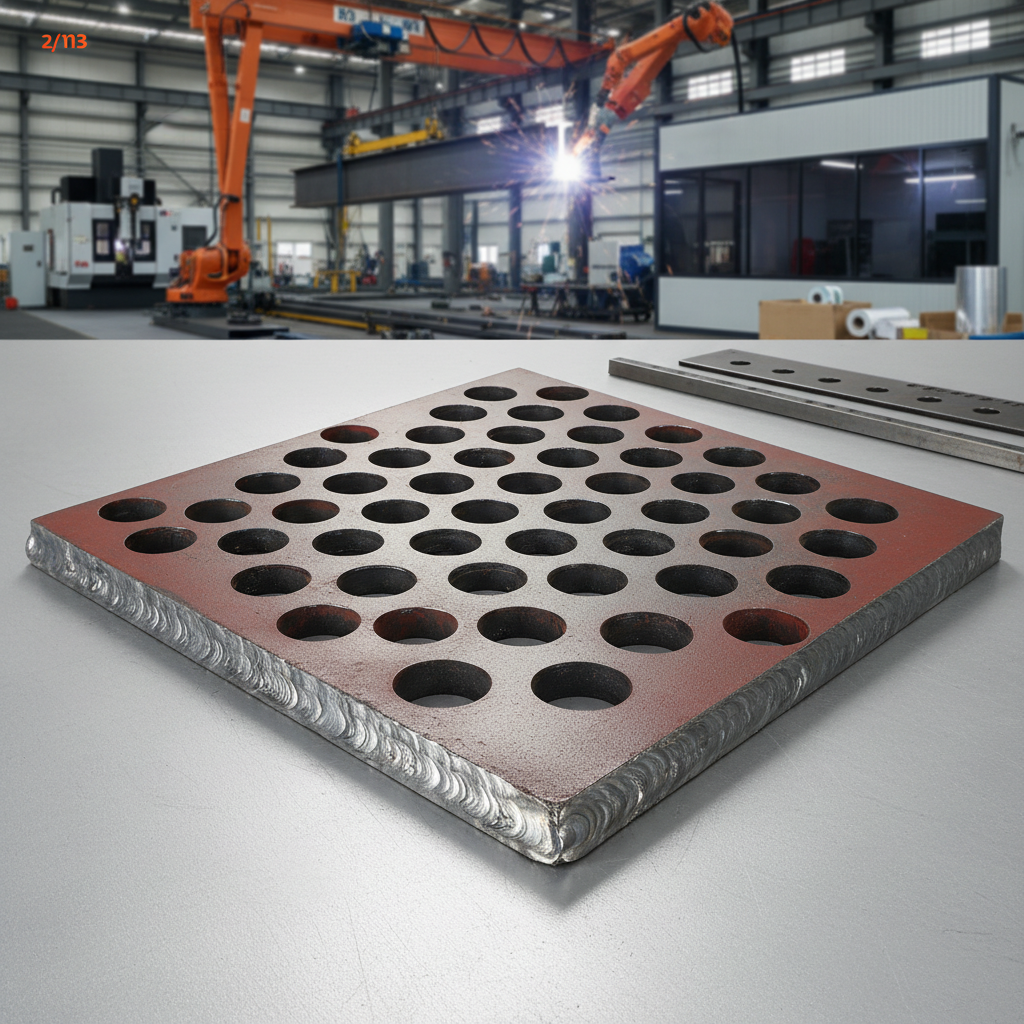
Selecting the right partner among various perforated plate manufacturers often determines the operational lifespan of industrial filtration and structural systems. In high-precision sectors, the difference between a standard punched sheet and an engineered perforated plate lies in the microscopic accuracy of the hole geometry and the metallurgical integrity of the material.
For procurement engineers, the challenge is no longer just finding a supplier who can "make holes," but identifying a manufacturer capable of managing complex alloys—such as Duplex 2205 or Hastelloy C-276—while maintaining strict dimensional tolerances. The shift toward specialized filtration in the pharmaceutical and oil and gas sectors has elevated the requirements for surface finish and structural reinforcement.
This technical guide examines the critical criteria for evaluating perforated plate manufacturers, focusing on the intersection of fabrication techniques, material science, and application-specific performance to help buyers minimize risk and optimize ROI.

The Engineering Complexity of Perforated Metal Fabrication

Perforation is often perceived as a simple mechanical process, yet high-end perforated plate manufacturers treat it as a precision science. The process involves a delicate balance between material removal (open area) and the structural stability of the remaining bridge. When dealing with structural metal products, an incorrect pitch or hole diameter can lead to premature mechanical failure under pressure.
Modern fabrication utilizes a variety of methods, from traditional CNC punching to advanced laser cutting and hydroforming. For instance, hydroforming allows for seamless cone geometries with ±0.5 mm accuracy, which is critical for aerospace fuel systems. The choice of technique directly impacts the burr height and the internal stress of the metal, affecting how the plate reacts to thermal expansion or corrosive environments.
The integration of quality validation, such as Helium leak detection (sensitivity 1×10⁻⁹ mbar·L/s), distinguishes professional manufacturers from general job shops. This level of rigor ensures that perforated plates used in ultra-high-purity gas systems do not introduce contaminants or allow bypass leakage, which could compromise entire production lines.
Critical Technical Parameters for Evaluating Plate Quality
When assessing a manufacturer's capability, one must look beyond the catalog and analyze the "Material Superiority" and "Fabrication Tolerance." A key metric is the Pitting Resistance Equivalent Number (PREN); for example, using Grade 316L with PREN ≥27 is standard for food-grade processing, but chloride-rich environments require Duplex 2205/2507 with PREN ≥35.
Surface treatment is another critical evaluator. Electropolishing to achieve Ra ≤0.2 µm is not merely aesthetic; it is a functional requirement for preventing biofilm accumulation in biopharmaceutical reactors. Without this specification, perforated plates can become breeding grounds for bacteria, regardless of the alloy used.
Furthermore, structural reinforcements like laser-welded ribs (2–10 mm thickness) are essential for plates operating in high-pressure environments, such as hydraulic power units exceeding 150 bar. A manufacturer's ability to integrate these reinforcements without distorting the perforation pattern indicates a high level of technical maturity.
Industrial Application Scenarios and Material Requirements
The application of perforated plates varies wildly across industries, each demanding a unique metallurgical approach. In the Oil & Gas sector, desander cones often utilize Duplex 2205 with 2 mm slots to handle massive flow rates (up to 50,000 bpd) while resisting the abrasive nature of sand and saltwater.
In contrast, the chemical industry requires extreme corrosion resistance. For catalyst retention in fluidized bed reactors, Hastelloy C-276 cones with 100 µm mesh are employed because they can withstand aggressive chemical reactions that would dissolve standard stainless steel. Similarly, PTFE coatings are applied to plates in paint spray booths to enhance ease of cleaning and chemical resistance.
Water treatment plants utilize perforated 316SS cones for backwash screens, where the focus is on anti-clogging and longevity. In these municipal systems, the balance between open area (for flow) and hole size (for filtration) is optimized to prevent membrane protection failures in MBR systems.
Quantifying Filtration Performance and Flow Dynamics
Optimizing flow dynamics is where engineering truly separates the top-tier perforated plate manufacturers from the rest. A tapered cone design, for example, can reduce turbulence and pressure drop by 20–40% compared to standard cylindrical filters. This efficiency directly translates to lower energy costs for the end-user.
Multi-layer construction allows for staged filtration, combining coarse outer mesh (1–5 mm pores) with fine inner layers (50–200 µm). This prevents the "cake" build-up from occurring too rapidly on the fine layer, extending the interval between cleaning cycles.
perforated plate manufacturers Performance Metrics
The data indicates that engineered perforated solutions significantly outperform generic plates in terms of flow efficiency and particulate retention. By adjusting cone angles (30°–60°), manufacturers can tailor the velocity of the fluid, ensuring that viscous fluids move without excessive pressure loss while gas-solid separations remain sharp.
Procurement Framework for High-Precision Metal Components
Procuring perforated components requires a shift from "Price-Per-Piece" to "Total Cost of Ownership (TCO)." A cheaper plate that clogs 20% faster or corrodes within two years costs the operation far more in downtime than a premium engineered solution.
Buyers should request detailed material certifications (MTRs) to verify the origin of the steel. TOMAIMESH, for instance, utilizes first-class raw materials from established groups like Taigang and Baogang to ensure metallurgical consistency. This prevents "rogue" batches where inconsistent carbon content leads to weld failures.
Additionally, verifying accreditation to standards such as AS 9100 or IATF 16949 provides a benchmark for the manufacturer's quality management system. These certifications ensure that the documentation and traceability of the product are as reliable as the physical plate itself.
Future Trends in Precision Punching and Chemical Etching
The industry is moving toward hybrid fabrication, where perforated plates are combined with etched metal mesh to achieve pore sizes that are impossible with mechanical punching alone. This allows for filtration thresholds down to 50 µm while maintaining the structural rigidity of a thick plate.
We are also seeing a rise in "Smart Perforation," where hole patterns are designed using computational fluid dynamics (CFD) to create specific flow profiles. This is particularly useful in hydrogen compression systems where ISO 8573-1 Class 0 compliance is mandatory, requiring absolute purity and zero particulate carryover.
Sustainable manufacturing is another driver. The move toward "Green Solutions" involves reducing material waste during the punching process and utilizing recyclable alloys. Future systems may rely more on additive manufacturing for extremely complex perforated geometries, though traditional punching remains superior for high-volume, high-strength applications.
Manufacturer Selection Matrix for Industrial Grade Plates
Choosing a supplier depends on the specific trade-off between precision, material capability, and volume. A manufacturer that excels in architectural steel grating may not have the clean-room facilities required for pharmaceutical-grade electropolished cones.
The following matrix outlines the selection criteria based on different industrial requirements to help procurement teams align their needs with the manufacturer's core strengths.
| Application Type | Recommended Material | Critical Process | Key Performance Indicator |
|---|---|---|---|
| Offshore Oil Separation | Duplex 2205/2507 | Hydroforming | Pitting Resistance (PREN) |
| Pharma CIP Systems | Super Austenitic 904L | Electropolishing | Surface Roughness (Ra) |
| Chemical Reactors | Hastelloy C-276 | Laser Welding | Acid Resistance |
| Food Processing | Grade 304/316L SS | CNC Punching | 3-A Sanitary Standard |
| Municipal Water | Standard 316SS | Flow Forming | Clog Resistance |
| Hydrogen Systems | 316L Low Carbon | Helium Leak Test | Particulate Class 0 |
Ultimately, the most reliable perforated plate manufacturers are those who offer customized product design and technical support. For those evaluating these specifications for their next project, comprehensive product data is available via www.tomaifilters.com.
Frequently Asked Questions
Conclusion
The selection of perforated plate manufacturers is a strategic decision that impacts the operational efficiency and safety of industrial systems. By prioritizing metallurgical integrity, precise fabrication techniques, and validated performance metrics, companies can avoid the hidden costs of premature component failure.
Whether for oil and gas desanders, pharmaceutical filters, or municipal water screens, the focus must remain on the alignment between material properties and application demands. For further technical specifications and custom design capabilities, professionals are encouraged to visit www.tomaifilters.com.